Research
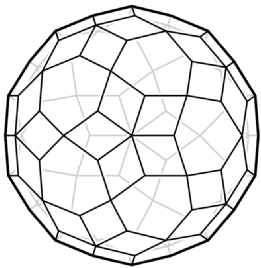
I work and publish on
- polyhedral combinatorics and geometry,
- geometric rigidity theory (polyhedral rigidity, second-order theory, …)
- graph theory (spectral, algebraic, geometric and topological),
- low-dimensional topology (knot theory, embeddings and embeddability of graphs and complexes, …)
- symmetries of discrete and geometric objects,
- convex geometry,
- real algebraic geometry,
- finite group theory and real representation theory,
- algebraic combinatorics (association schemes, distance regular graphs, codes …),
- random structures and graph limits,
- discrete dynamical systems,
- …
My current main project is on the Wachspress Geometry of convex polytopes.
Polytopes
Polytopes can be defined either as the convex hull of finitely many points or as the (bounded) intersection of finitely many halfspaces. Their purpose is to generalize polygons and polyhedra to dimensions four and above. As convex bodies they are clearly objects of convex geometry. But their boundary carries an intricate combinatorial structure which makes them accessible by tools of combinatorics. The interplay of the combiantorics and geometry often invovles algebraic geometry.
Polytope theory is at the core of my mathematical interests and many other questions and topics I work on have some aspect of polytope theory.
Rigidity theory deals with the local and global uniqueness of geometric structures. Historically mathematicians studied bar-joint frameworks: straight line embeddings of graphs. The main question is usually: can the frameworks be deformed while preserving all edge lengths? I study rigidity theory mostly in the context of polytope theory.
Spectral graph theory studies graphs by extracting information from the spectrum of the graph’s adjacency matrix or Laplace matrix. Algebraic graph theory studies graphs of high symmetry or regularity. Spectral techniques have been established as very powerful tools for algebraic question, and so these topics go hand in hand. Spectral graph embeddings can furthermore be used to obtain geometric embeddings of graphs that reflect the graphs combiantorical properties geometrically. I have been working on spectral embeddings of polytope skeleta. A modern core result here is Izmestiev’s theorem which states that all polytope skeleta are spectral embeddings of the edge graph.
Topological graph theory studies graphs as topological spaces, and properties and graph classes defined on that point of view. Prominent examples are planar, linkless and knotless graphs. Topological graph theory is intimately linked to graph minor theory because many topologically defined graph classes can be characterized by excluded minors. I studied 4-flat graphs, which are a 4D analogue of planarity. Through this I became interested in low-dimensional topology, and in particular, the embeddability of 2-dimensional CW-complexes in \(\Bbb R^4\), the only case where the well-understood homological obstructions fail to be complete.
Lean is a modern tool for formalizing mathematical proofs. I am working on formalizing polytope theory in Lean.